DOORSTOP WITH MINISTER MCBAIN | GEELONG
SUBJECTS: Regional Precincts and Partnerships Program; ISIS Foreign Terrorist Fighters’ Wives; AUKUS; Nakamal agreement.
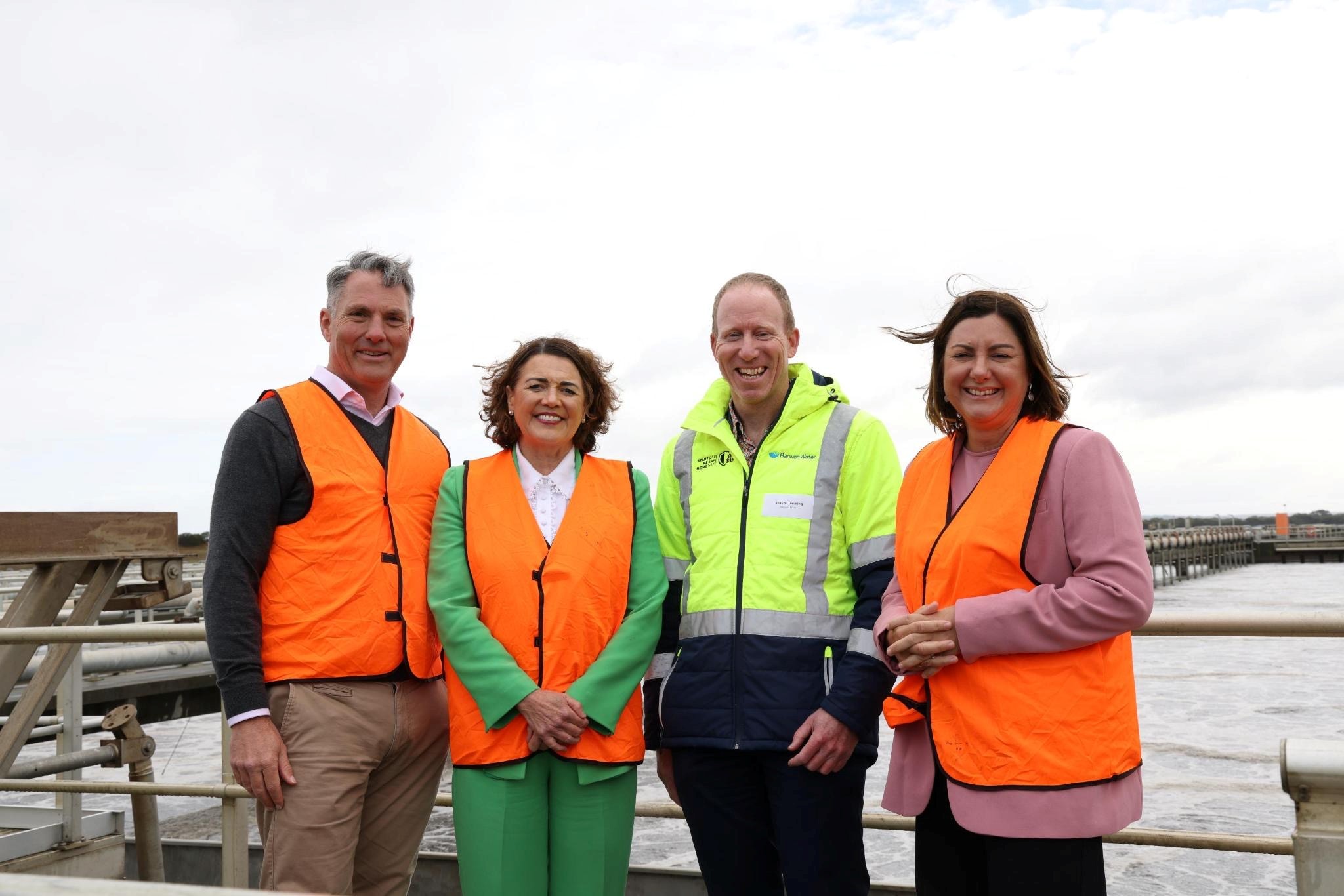
LIBBY COKER, MEMBER FOR CORANGAMITE: Good morning, we’re here at the Black Rock sewage treatment plant with an exciting announcement regarding biochar use from organics. The Federal Government has made a significant contribution and I have with me today the Deputy Prime Minister and Member for Corio, the Honourable Richard Marles, and I also have Kristy McBain, the Honourable Kristy McBain, who is Minister for Regional Development and Local Government. So I’m going to hand over now to Kristy to make the announcement.
KRISTY MCBAIN, MINISTER FOR REGIONAL DEVELOPMENT: Thanks so much, Libby and it’s great to be here today with yourself, who is a big supporter of not only this project, but this local community, and Deputy Prime Minister, Richard Marles. Today we are announcing $20 million to Barwon Water’s project, which is all about making sure that we can use organic waste and turning it into saleable, commercial products. This is a huge investment in what will be quite an innovative process and we know that this can be replicated across the country. This is part of our Government’s $400 million commitment through our Regional Precincts and Partnerships Program and this really is ticking all the boxes. Barwon Water, together with four local councils and with First Nations people, determining that this project is something that is innovative, worthwhile and we are investing in it because we want to see more of it.
RICHARD MARLES, DEPUTY PRIME MINISTER: Well it’s great to be here with Libby Coker, the Member for Corangamite – Libby and I, in terms of our electorates, are really covered by Bowen Water so this is a really important facility for us – and it’s fantastic to have Minister Kristy McBain, the Minister for Regional Development, here to make what is a fantastic announcement. Barwon Water has been a leader in terms of the circular economy, recycling in the context of the treatment of waste. One of the first water authorities around the country to see the recycling of water around this region. The announcement that we’re making today actually takes a pilot project in terms of the development of biochar and brings it up to scale. And this is a really important product which will be able to make a much more efficient use of fertilizer. Given all the challenges that we are having right now in terms of the global supply chain in relation to fertilizer, this is going to be a really important initiative to help make fertilizer much more efficient for farms within the region. And in turn, what this does is build the resilience of the region. This sort of project will help build the resilience of the nation. It helps the economic productivity of this region, and with that, it allows population growth. And that’s something that we are very much looking to see in the Geelong region. In the southern part of Geelong, where we are now, we’ve seen really significant population growth. This initiative, being able to treat waste in this way, create a circular economy, helps enable us to sustain a much bigger population in this region, which is a great thing. We are really appreciative for the work that Kristy has done, I thank Libby for her advocacy, and a real congratulations to Barwon Water on the achievement of this announcement today.
JOURNALIST: A couple of quick questions. On the ISIS brides, the women and children coming back to Australia, a Syrian government official has told the ABC they had to wait until Australia put procedures in place before the group could fly out. Has the Government been in contact with Syria about that group, and what are the procedures?
MARLES: Well look, we have consistently said in relation to this that the Government has provided no assistance here. We are not repatriating these people. We’ve also made it really clear that anybody who has been in breach of the law will be met by the full force of the law if they come back to Australia– when and if they come back to Australia. And the final point I really want to make here is that our security agencies, in respect of everyone that comes to this country, have a really clear sense of maintaining the security of the Australian people. And as a Government, we have complete faith in our security agencies and they are at work here in respect of this.
JOURNALIST: What do you make of growing suggestions that Australia should be looking at contingency plans in case the delivery of these Virginia class submarines to Australia is delayed from the US?
MARLES: Well, I mean, we get asked that question repeatedly. The bottom line here is we need to stick to this program. When people talk about contingencies, plan B’s, it’s really not about pursuing a plan B. If you keep shopping and changing, as the Coalition did during their time in government, you’re really making a decision not to have submarines at all. And as a nation, you only need to look at our geography, surrounded by oceans. It is fundamentally important that we have a highly capable, long‑range submarine capability, and that is what we’re pursuing. This is a program which has been supported by the governments in Australia, the United Kingdom and the United States. In all three countries we’ve seen changes of government since AUKUS was first announced and I have absolute confidence that we will see the transfer of Virginia class submarines to Australia on time in the early 2030s. AUKUS is happening on track and at a pace.
JOURNALIST: So what gives you confidence that the US will agree to deliver those submarines to Australia, even if its domestic shipbuilding targets are not being met by early next decade?
MARLES: Well firstly, we have a treaty with the United States in relation to this. That’s meaningful, right there. But secondly, in terms of what we are contributing to the US, both financially but also in terms of people within its sustainment program, we are seeing real progress in terms of their industrial base in getting Virginia class submarines out to sea for the US Navy. So that is on track, and we are confident that there will be the space there to provide for the transfer of Virginia class submarines to Australia as part of the plan.
JOURNALIST: And you asked the top of volcano last year to give initial agreement to the Nakamal agreement with Vanuatu. The negotiations now are looking a bit bogged down. Are you worried that China is now pursuing its own strategic agreement with Vanuatu?
MARLES: Well, we have a really good relationship with the Vanuatu government. We continue to work closely with them as a fundamental partner for Australia in the Pacific and we look to optimism about the future of that relationship and agreements which will come about between Australia and Vanuatu.
JOURNALIST: Have you sought any assurances from Vanuatu that there are no security elements to that pack with China?
MARLES: We work really closely with the Vanuatu government, and we are really confident about the future of our relationship with Vanuatu and the future of the negotiations that we’re undertaking with Vanuatu.
ENDS